
Challenge: The “black hole” effect in legacy systems
In the logistics sector, reliability is the primary currency. I took on Space, a GPS monitoring solution launched in 2012 as a hybrid web app. After a decade, the product suffered from what I call the “black hole effect”: an obsolete interface, sluggish response times, and a critical disconnect between mobile user expectations and system capabilities. My role as Lead UX/UI Designer & Researcher was to spearhead the transition toward a dynamic, native experience.
Beyond aesthetics
To drive business metrics, I conducted deep-dive research (contextual inquiries, surveys, and competitive benchmarking). We identified that 50% of user frustrations stemmed from the inability to execute real-time actions on the fleet.
- Users felt hindered by the lack of immediate operational control from their devices; they required immediacy and command.
- We mapped task flows specifically for our “Juan the operator” archetype, ensuring monitoring, reporting, and notification management were just one tap away.
- I used the MoSCoW method to streamline features and ensure the MVP addressed the most urgent business needs.
Brand

Brand perception was “distant and weak.” In industrial environments, legibility and recall are vital.
- Redesigned the visual identity, refining symbol symmetry and scale to ensure adaptability and legibility on mobile screens.
- Refreshed the color palette to guarantee high contrast for outdoor use and high-mobility environments.
Testing and iteration
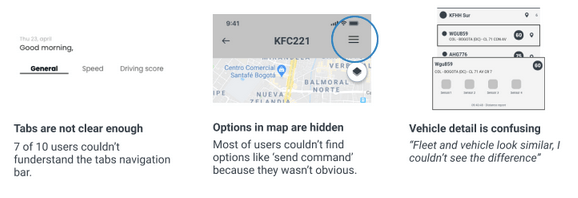
The value of iteration is failing fast to succeed, during unmoderated usability testing with 10 participants, data challenged our assumptions:
- 7 out of 10 users struggled with tab-based navigation.
- Critical command functions were buried, hindering operational speed.
- The pivot: Refined the IA, redesigned accordion components to distinguish info from interaction, and simplified the vehicle detail view.

Business Impact
Business gained in efficiency & scalability
- Delivered a scalable native app (iOS, Android, and later HarmonyOS).
- Established a robust Design System & white-label architecture.
- 80% reduction in design time for white-label deployments.
- 40% faster implementation times due to documented design system components.