
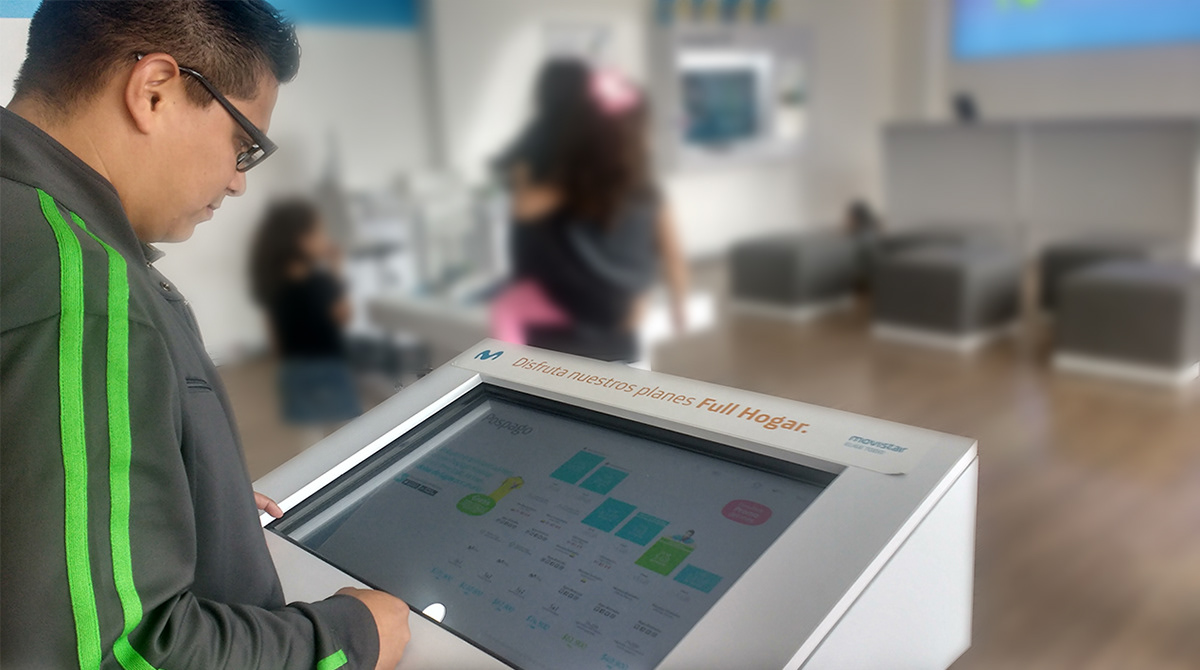
Creation of an interactive digital catalog and self-service touchpoint deployed on 32″ industrial touchscreens (Model ET3201L) at national service centers in Colombia. This digital product bridged the gap between the physical store experience and digital depth, allowing users to explore mobile plans and smartphone catalogs autonomously.
The problem
Operational friction in high-traffic service centers, the bottleneck is human capacity. We found sales consultants were frequently distracted from high-value sales to answer repetitive, low-impact queries. The goal was to design a self-service ecosystem to absorb this volume.


Archetype-centered design
- Andrés (The proactive consultant): The solution acted as his “co-pilot,” allowing him to show technical comparisons and complex plans visually.
- Natalia (The autonomous user): We optimized for interactivity and speed, allowing her to self-serve while waiting.
- Carla (The efficient B2B analyst): Dictated the need for a hierarchical IA to find corporate connectivity solutions quickly.
Technical Constraints & Engineering
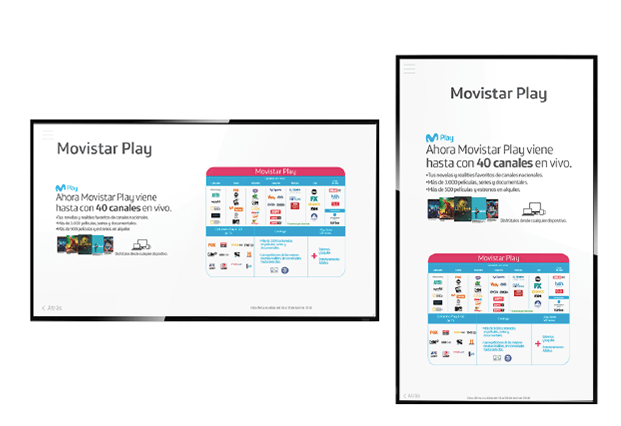
We developed a responsive solution using HTML, CSS, and Bootstrap to ensure a fluid experience across portrait and landscape screen configurations nationwide. Included dynamic sections fed by a central database for real-time updates.

Data over Intuition
Post-launch Google Analytics showed lower interaction than expected. Users enjoyed physical device interaction but felt “screen-shy” with the kiosks.
- Friction point: Lack of a clear “entry point.”
- The solution: Iterated by implementing animated Call to Action (CTA) buttons.
- Results: ~35% increase in user interaction after the optimization.


Conclusion
We used the design as an efficiency catalyst, because the digital transformation in physical spaces isn’t just about hardware; it’s about user psychology at the Point of Sale (POS). We reduced consultant workload while increasing customer autonomy. This project proves that success lies in the ability to iterate based on real-world behavior.